Showing posts with label Obscure Varietals. Show all posts

Sunday, July 25, 2010

San Benito County--the Languedoc of CA--Plus Lots on Kennth Volk

I came across some interesting wines from San Benito County yesterday at Kenneth Volk's tasting room in Santa Maria. His Negrette from Caleri Vineyard in San Benito County is fairly well known in the wine nerd world--apparently the variety is only grown in San Benito County in CA (maybe a few other places?) and near Toulouse in France. I've had this before, but yesterday came across some even more fascinating esoterica.

There's an 85 year old vine Mourvedre from Enz Vineyard in Lime Kiln Valley (pictured left), a sub-AVA in San Benito. I didn't take careful notes--I was too excited by all of these interesting wines--but it definitely had the concentration, spice and funk of a good Mourvedre. Mourvedre isn't that rare, but vines this old are! Volk also has Cabernet Pfeffer from Siletto Ranch in San Benito County, which to me had a very peppery if not tobacco-y aromas. Supposedly this is actually the varietal Gros Verdot, though an alternate explanation claims it's a cross of Cabernet Sauvignon and another grape variety by a guy named Pfeffer. I have no idea on the age of the vines though. Made me think of a Chinon perhaps or Blaufrankisch.

Another interesting one is his Touriga Nacional from a vineyard in the Templeton Gap in Paso Robles, Pomar Junction. Definitely young vines. This is by far the most floral and spice laden red wine I've encountered next to Lacrima di Morro d'Alba. Touriga I suppose isn't that rare, but finding it is a varietal wine isn't something you see every day.

As a side note on Kenneth Volk, the guy is clearly driven to explore these rare grapes. I don't think every wine he makes works. His is Viognier was bordering on raisined flavors, for example, though that will have appeal to others and it's probably too hard to get all these disparate vineyards exactly as he'd like. But the majority really express unique character. Too often CA vintners simply take an unfamiliar varietal and turn it into another ripe, oaky wine with a different name. It's also pretty compelling that many of these "heirloom" varietals are not produced in any quantity anywhere in the world. Often times wineries use an important grape less known to CA consumers and make an overpriced, inferior young vine version compared to the old vine, old world equivalent. Volk is finding vines and grapes so unique that there aren't any equivalents anywhere. I don't even think Bandol has 85 year old Mourvedre vines as it was largely replanted in the mid-20th century after Phylloxera wiped out most of it.

OK, so this is turning out to be more about Volk than San Benito County. But it seems he's a big advocate for this region. I'd like to dig deeper on this area as it appears to be a very old region that's recently been rehabilitated, much like Languedoc. Surely there are some areas best for bulk wine, but given some of the old vines, the limestone soils in some areas, and the adjacent mountain range, there must be terroirs with stunning raw materials. And not just that, but unique and essentially indigenous grapes. The location at the top of a valley even sounds promising as it should be warmer than Monterrey, but still get cooling influence from the Pacific.

Monday, February 22, 2010

TN: Albert Mann 2007 Alsace Auxerrois Vielles Vignes

Auxerrois, by most accounts, is a minor varietal. But most of the noble Chardonnay by all accounts (if you go by volume) is pretty insipid. So, for less than an Andrew Jackson I figured the Albert Mann 2007 Alsace Auxerrois Vielles Vignes was worth a shot. It's from a cool region (Alsace), a good producer (Albert Mann), and old vines (Vielles Vignes).

Upfront in the bouquet has a mildly distracting roasted coffee note that could either be a byproduct of oak or reduction. I suspect I'm especially sensitive to the volatile thiol furanmethanethiol, though, so this is likely not going to bother most people. The nose also has plenty of pear and floral aromas. On the palate, the acidity is tingly and clearly pretty darn high. But there's a pine resin-like sensation lending body as well as a fruity, off-dry flavor. So ultimately the balance is there. Earthiness shows up on the finish.

Interestingly, David Schildknecht's review finds many of the same qualities, though Schildknecht's superior palate, decades of experience, and analytical approach yield a more complete note:
The Mann 2007 Auxerrois Vieilles Vignes smells of grapefruit and orange peel, fresh apricot, narcissus, and a fascinating smokiness and Chablis-like suggestion of chicken stock and shrimp shell reduction. Rich and silky on the palate, its slight suggestion of sweetness is appropriately countered by chalky, wet-stone, as well as savory suggestions of minerality and the faint bitterness of toasted nuts and citrus zest, but as the wine opens over time, subtly sweet peaches-and-cream and orange sherbet become more prominent. Enjoy this versatile beauty anytime over the next 2-3 years.
This is not quite a re-buy for me, but it was a good palate educator for the price. It also went well with goat cheese. Yum! This is a good reminder that David Schildknecht is one of the best critics out there, especially when it comes to cool climate wines. It's unfortunate that his intellectual, thorough approach is often buried in the noise of the pretentious, blustery style of his peers.

Pros: Aromatic, Fresh, Food Wine
Cons: Toasty Thiol Aroma
Decant: No
Price: $18 from Wine House
QPR: Fair (out of Poor, Mediocre, Fair, Good or Excellent with Fair denoting expectations were met for the price point)

Monday, November 30, 2009

WN: Braunstein 2004 Leithaberg Rot

The Braunstein 2004 Leithaberg Rot has a lot going against it, which is probably why I found it several months ago on sale for $20. It's priced at 20 Euros typically, which translates to about $40 for us Americans. Rot just doesn't sound sexy even though all it means is red. Meanwhile, the wine consists of 75% Blaufränkisch and 25% Zweigelt. What kind of rot-blooded American would drink anything other than Zin, Cab or Chard? Blaufränkisch also goes by the aliases Lemberger, Blauer Limberger, Frankovka, Franconia, and Kékfrankos, just to name a few. How are you going to abbreviate it to one syllable for sale to the masses if you don't even know what to call it? And do the masses even know what an umlaut is?

In short, we have a rot wine made from a varietal that sounds like a stinky cheese. That's a recipe for a discount, regardless of quality. Since I like value and exploring unfamiliar wine regions--in this case it's Leithaberg in the eastern-most Austrian state of Burgenland--this one was a no brainer.

I didn't know quite what to expect from this wine. Blaufränkisch, according to its Wiki, is a late ripening grape that makes a dark wine with fruity and spicy flavors. Other sources compare it to Merlot and Gamay Noir, and suggest it makes a good introductory wine due to its medium body, lighter tannins and fruit-forward flavors. (Aside: I'm not so certain about the latter statement as new wine drinkers are often most attracted to powerful, oaky wines with varietal names like Cab or Chard or unstructured, slightly sweet wines like Charles Shaw, YellowTail or any generic Pinot Grigio.) Zweigelt, meanwhile, is a cross of Blaufränkisch and St. Laurent that is supposedly more cold hardy and ripens earlier. Since it tends towards high yields, it may produce a pedestrian wine without hard work in the vineyard.

As it turned out, the descriptions were pretty much on-target. The wine was dark in color, but had the medium body and light tannins of a good Pinot Noir. It definitely was not a beginner's wine, though. While there were aromas and flavors of cherries and raspberries, tobacco was the most prominent component of the wine. It was most obvious in the bouquet and the finish where it added a savory layer of complexity to the fruit forward attack. The acidity was medium low, but appropriate for the weight of the wine. There was also a light impression of high quality oak that added some mid-palate presence, yet was wholly complementary.

Wines labeled with the Leithaberg appellation, according to their website, must express their terroir, avoid the international (Parkerized) style, and possess balance and elegance. Having read their PR copy after tasting the wine, I'd have to say that it's 100% true. Not only did this wine express a unique character, it's flat out good.

Even at $40 full retail price, this wine would be fairly priced. I feel like I practically stole it for $20. It's essentially a better and more mature version of the 2007 Pied de la Butte I recently tasted. Then again, I love the tobacco of a good Cab Franc, and I love the supple elegance of a good Pinot Noir. This wine brings both of these qualities together. I'd even hazard to guess that if given more age, the fresh tobacco aromas might evolve into an even more complex cigar box bouquet, though it might come at the expense of some of the delicious fruit this has now.

The Braunstein 2004 Leithaberg Rot is a stunning, awesome wine. I'm adding Leithaberg to my list of regions like Chinon, Bourgueil, Bierzo and Mount Etna that can produce superior medium bodied wines of terroir without the exorbitant prices Burgundy or California will often demand. Everyone should put down their glasses of over-extracted Napa Cabs and go out right now to try something from Leithaberg. If you can find it!

Pros: Tobacco, Red Fruit, Medium Bodied, Balanced, Elegant, Deep, Complex, Seamless, Long Finish
Cons: None
Decant: Yes
Price: $20 from K&L Wines
QPR: Excellent (out of Poor, Mediocre, Fair, Good or Excellent with Fair denoting expectations were met for the price point)

Monday, November 23, 2009

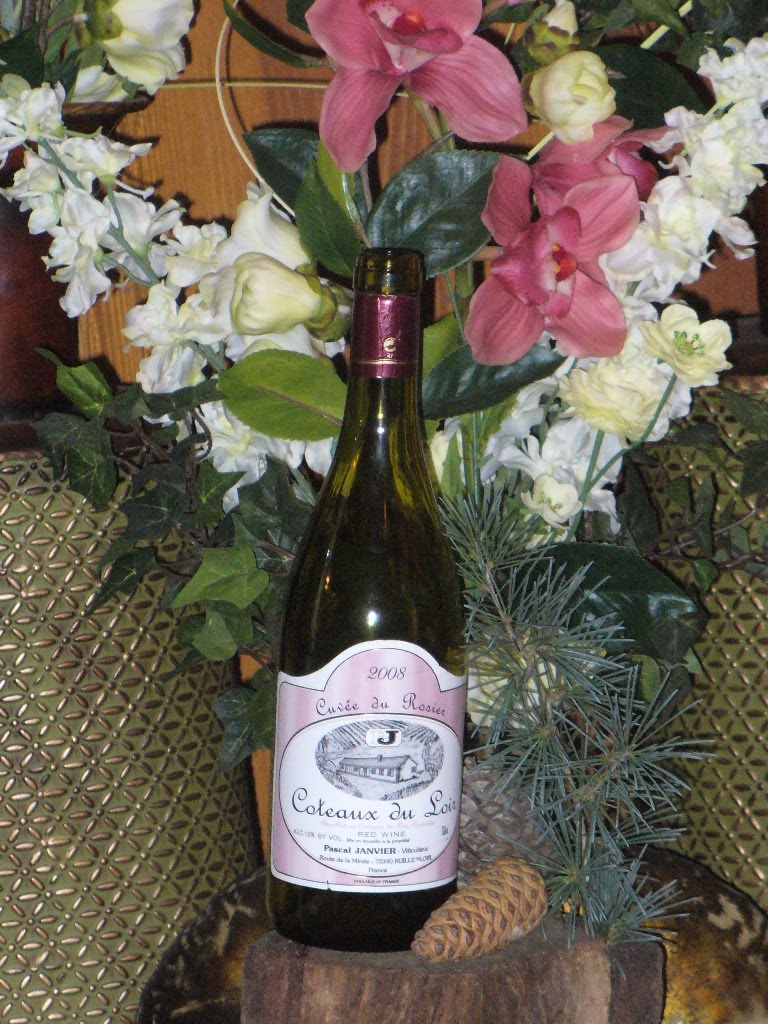
TN: Pascal Janvier 2008 Cuvée du Rosier

Get ready, here's another Kermit Lynch import: Pascal Janvier 2008 Cuvée du Rosier. The varietal of record here is Pineau d'Aunis, which has all manner of bizarre characteristics ascribed to it such as the flavor of pure pencil lead and Pinot Noir spiked with Pine Sol. Moreover, the wine hails from the Loire appellation of the Coteaux du Loir (that's not a typo, Loir has no 'e' in this version), an apparent ellipse of vineyards nearly due north of my beloved Chinon and Bourgueil.

Clearly, this is not going to be your typical tasting experience. Here are my notes:
Whoa! This wine defies numerical ratings, it's in its own orthogonal space. The bouquet resembles a good Beaujolais. There's tart red fruits like pomegranate and cranberry. Then pepper and meat. The flavors are very much cranberry-like, too. Tart red fruit attacks, then the bizarre finish sweeps in. It reminded me of retsina, the Greek wine made with pine resin. While it was weird to me, it didn't make me shudder. There are dusty tannins despite the rosé-like weight and color of the wine.

There was also a slight tongue tingle, maybe due to in-bottle fermentation. Decanting will get rid of this. This would be a flaw in a generic wine, but I suspect in the curious world of 'vin naturale,' this is a feature. Regardless, the purity of this idiosyncratic wine was impressive.
Strange yet not cringe-worthy sums it up. My girlfriend felt differently, however, so this is not going to be a general crowd-pleaser. It's a food wine, for certain, as it is intensely dry and mineral-laden in nature. And I have a suspicion that very little sulfur dioxide was used, which likely means each bottle will be unique like a snowflake. In-bottle malo-lactic fermentation can yield a slight spritz of carbon dioxide as well as meaty aromas, thus I suspect there might have been a bit of ML taking place.

Flawed? Unique? Memorable? Bizarre? Fascinating? Brilliant? Welcome to the outside of the box. I'm not sure I'd want to live there as some wine geeks do (see Feiring, Alice), but it's an interesting place to visit. I think I'll take 20% new French oak and sulfur dioxide before bottling 90% of the time. This is for that other 10% of the time.

Pros: Fresh, Dry, Light Body, Food Friendly
Cons: Potential Bottle Variation, Difficult/Weird Resinous Finish
Decant: Yes, allows CO2 to dissipate
Price: $17 from K&L Wines
QPR: Fair (out of Poor, Mediocre, Fair, Good or Excellent with Fair denoting expectations were met for the price point)

Tuesday, October 6, 2009

TN: Curran 2007 Grenache Blanc

The Curran 2007 Grenache Blanc is the Rhone white for fans of Riesling. I haven't had many Grenache Blancs, so the best I can do is compare it to other varietals. The Curran version is suggestive of a hypothetical mix of Viognier and Riesling. Perhaps Viognier isn't a great comparison; Viognier is usually reminiscent of apricots and honeysuckles. Grenache Blanc is more reserved, and this version was quite focused on pears and apples. But they do both share the same oily viscosity and tendency towards floral expression.

What really made this wine sing was the bracing acidity and hint of kerosene that is typical of Riesling. The initial attack gives the impression of being slightly off-dry, but the acidity, as it would for a Riesling, clears the palate and unleashes a long, minerally finish. Topping it all off is a very light dusting of tannin that barely exceeds the threshold of detection.

I don't write about many white wines, but this is one of the rare white wines that shows the complexity and depth of a red wine. It's just that the amplitude of the components is toned down. Usually whites for red drinkers take the buttery Chard route, using the grape as a substrate for myriad winemaking tricks. But Kris Curran's approach is more sensitive, and it's clear she is exceedingly talented at coaxing profound expression from her grapes.

Pros: Aromatic, Crisp, Long Finish, Minerality
Cons: Slightly Flabby Entry
Decant: Maybe
Price: $23 from Curran Wines
QPR: Fair (out of Poor, Mediocre, Fair, Good or Excellent with Fair denoting expectations were met for the price point)

Saturday, October 3, 2009

TN: Benanti 2005 Etna Rosso di Verzella

Quite simply, this is a mind-boggling QPR. The Benanti 2005 Rosso di Verzella hails from the slopes of Mount Etna in Sicily. Wines from such a southern region typically are dense and alcoholic, but the extraordinary elevated volcanic terroir lends itself to an unusual wine. If this Benanti is at all typical, these wines, which are generally a blend of the indigenous varietals Nerello Mascalese and Nerello Cappuccio, possess an ethereal and supple quality quite similar to Pinot Noir.

The bouquet of this wine is constantly shifting, hard to pin down, which I tend to find more often in traditionally oriented wines from the Old World. While I think it possessed some volatility, though not enough to suggest a flaw, the nose has Sangio-like ripe cherries, a little leather and smoke, capsicum, dust and floral notes. Nice bouquet, but an even better palate. The entry shows juicy cherry flavors with good viscosity like a New World Pinot, then evolves into a warm blanket of supple earthen pleasure. There was a certain silken quality that one only finds in very good Pinot Noir and, on occasion, Cabernet Franc. Seamless is the word, and balance is its natural complement. The acidity is a bit on the low side from my perspective, yet this medium-bodied style that relies on subtlety doesn’t really need an aggressive acidic counterpoint like a massively fruity wine would.

Imagine a cross between a Bierzo and a Pinot Noir, and this is what you get, but for a mid-level Bierzo price of $16, not a $40+ Pinot price tag. This is one of the best wines I’ve had at this price point. Rarely does a wine achieve finesse, characteristic expression, and outright deliciousness under $20. Often you get one or two, but not all three qualities. This wine would hold its own with wines double if not triple or quadruple its price, in my opinion.

Pros: Supple, Balanced, Earthy, Medium Body, Complex
Cons: None
Decant: Yes, it kept improving with time
Price: $17 from K&L Wines
QPR: Excellent (out of Poor, Mediocre, Fair, Good or Excellent with Fair denoting expectations were met for the price point)

Sunday, April 26, 2009

WN: Lacrima di Morro d'Alba & Valpolicella Classico Superiore

Italy is a country whose wines I'd like to visit more often. No other nation seems to have quite as immense an array of growing regions and varietals as Italy. There are the big names like Amarone, Barolo, Barbaresco and Brunello if you are looking for a way to drop $50+ on a bottle of wine. Being the value conscious buyer that I am, I've been looking into the dozens if not hundreds of varietals and regions (Italy has an utterly confusing appellation system based on IGT, DOC and DOCG designations) that aren't as well recognized as the most noble wines of Italy. There's a general perception that Italian wines aren't good values, but that depends on your perception of value. If you're looking for a unique wine that synergizes with food, the lesser-know appellations of Italy have much to offer. A good recent white wine find was the Suavia 2007 Soave Classico, a blend of 95% Garganega and 5% Trebbiano di Soave that's well balanced and slightly reminiscent of green apples. Pictured here are the Caterina Zardini 2005 Valpolicella Classico Superiore and the Luciano Landi 2006 Gavigliano Lacrima di Morro d'Alba. Both are moderately priced and show loads of character.

The Zardini 2005 Valpolicella is a blockbuster styled wine made from 60% Corvina and Corvina Veronese and 40% Rondinella, but a blockbuster that's unique enough to keep it from slipping into an abyss of anonymity. I couldn't help but imagine this wine as anything other than a Clint Eastwood spaghetti Western. Certainly it's a full bodied masculine wine with a smooth round entry, sweet mid-palate and polished, yet tannic finish. I would be surprised if this wine didn't see significant barrel aging; however, the oak is tastefully integrated to provide a crowd-pleasing New World-styled palate. However, the bouquet is a stark departure from the sweetly fruited palate. The Man with No Name was always chomping on a cigar while he glared out over miles of parched brush. Convert that image to a smell and that's the bouquet of this wine. Dusty, dry, vegetative and reminiscent of burnt tobacco (or slightly more pejoratively, an ash tray). One can smell that sweet berry jam a bit, too, but fortunately the scowling bounty hunter aromas win out.

One should expect a Valpolicella to be fairly rich and unctuous. Valpolicella is typically produced like a less-intense Amarone. Amarones are made by drying out grapes on mats to essentially raisin the grapes, which produces a concentrated and powerful wine. While the sweetness of this wine was eventually a little overbearing and it's only built to pair with very rich foods, one must appreciate that it captures an intriguing combination of traditional expression, New World polish, and fascinating (if potentially off-putting) aromatics.

The Landi 2006 Lacrima is a very feminine wine in comparison. Lacrima di Morro is an ancient varietal that is known for its hauntingly floral bouquet. Or at least that's the description that motivated me to order this wine. It didn't disappoint. The bottle lists rosa canina and marasca as the floral aromas it evokes; I have no idea what these blossoms smell like, but the floral 'theme' is right on the mark. The wine smells almost like a fragrance with slightly pungent floral aromas, more fragrant rosy aromas, and a musky slightly spicy cinnamon-like smell as well. I'm tempted to say this is 4 parts perfume, 1 part cologne on the nose. Divide it as you'd like, this is a red wine that compares to even the most flamboyant of white wines in terms of its floral expression, though they are not high-toned like the honeysuckle or jasmin typical of aromatic white wines.

The palate screams 'food wine' with its combination of acidity, linear flavors and minimal oak influence. Light tannins complement flavors primarily of sour cherry. It certainly became more complete on its own over time, but the food-wine combination was greater than the sum of its parts. Whereas the Valpolicella became flabby and ungainly, the Lacrima picked up more weight and enhanced the food as well. Was one of these two wines better than the other? Well, I liked the Lacrima slightly better because I consider floral aromas a rare and highly desirable trait in any wine. A professional reviewer would almost certainly rate the Valpolicella significantly higher based on the strength of its full-bodied palate. But both performed admirably in the appropriate context and absolutely 'oozed character' as I like to say.

Caterina Zardini 2005 Valpolicella Classico Superiore
Score: 87-90
Price: $20 from Winelibrary

Luciano Landi 2006 Gavigliano Lacrima di Morro d'Alba
Score: 89-92
Price: $17 from Wine Exchange

Sunday, April 19, 2009

WN: Huber Cellars 2005 Dornfelder

What do you get when you cross Helfensteiner and Heroldrebe? Dornfelder, of course! If this reads like a German joke that doesn't quite come through in translation, you are definitely on the right track. Dornfelder is a hybrid varietal native to Germany known for its dark, inky color and its ability to produce a hefty, masculine wine even in cooler growing regions. Southern California might not seem like the ideal location for such a grape since there's no shortage of warm weather or varietals that can produce powerful wines. However, the Huber family grows Pinot Noir in the Santa Rita Hills appellation, which is rather foggy, windy and even chilly by California standards. The Hubers are of German ancestry, and when German friends presented them with Dornfelder vine stock, they decided to give it a shot.

Based on the Huber 2005 Dornfelder, I'd say this was a well-gauged risk. The Santa Rita Hills AVA will ultimately be known for its Pinot and Chardonnay, but Dornfelder seems to be as well matched as Syrah, which produces very profound wines when grown in cool regions, to the area. The first thing you'd notice about this wine is that it has a proclivity to stain anything that comes in contact with it. Even the green glass of its bottle is dyed an eerie deep maroon below the neck. A little sediment caked on the bottle is fairly common, but this was a staining deposit of pigment. A similar effect could be seen in the decanter and glass, though fortunately the effect was not permanent. This Dornfelder is not so much a red wine as a black wine, and it coats everything in its path with an ominous, dark veil. The effect is similar to that of a teinturier like Alicante Bouschet, though as far as I know Dornfelder does not have dark pulp and all the pigment comes from its skins.

The impression the flavors and bouquet offered is also similar to that of Alicante Bouschet. The bouquet is very primal and grapey, with some gamey, mushroomy and floral notes present as well. The seeming viscosity of the wine in the glass is also evident on the palate; it's concentrated and thick. However, the acidity is also fairly pronounced, which prevents the wine from becoming a circus of exaggerated features. The presence of soft tannins rounds everything out, giving an integrated impression of a balanced wine. Indeed, it's delicious, though the acidity suggests it's better paired with food than without. Right now it's a mouthful of red (well, black) wine and might have a more elegant disposition in a few years. Despite its rambunctiousness, you do get a wine brimming with character and a ton of stuffing for a very reasonable price of $20, especially when 'average' Pinot Noir from Santa Rita Hills often runs about $40 (average relative to its SRH peers, though the average quality is outstanding).

Score: 87-90
Price: $20 from Huber Cellars

Sunday, March 29, 2009

WN: Descendientes de J. Palacios 2006 Petalos

No sooner had I opened a bottle of the Descendientes de J. Palacios 2006 Petalos than Eric Asimov of the New York Times had published an article on the wines of Spain's Bierzo region. While I'll still stake claim to this "discovery" as my own, the word is out. Bierzo is chic; so chic in fact that the New York Times is raving about it. And if Petalos was not quite good enough to crack the top ten of Asimov's list, then how how good must those in his top ten be? This wine was easily the best Spanish wine I've had--though all my Spanish purchases have been in the under $20 range--and also has to be one of the best quality to price ratio purchases I've made.

I actually "discovered" Bierzo browsing through the Wines of the Times archives. Yes, once again Eric Aimov got there first, as he typically does when it comes to interesting wines from Old World regions. The distributor of Palacios' wines, the Rare Wine Company, can give you a pretty good idea about what is different about Bierzo. The images on their website with the caption "an extraordinary terroir" offer a pithy summary. The indigenous varietal of Bierzo is Mencía, a grape that is often compared to both Cabernet Franc and Pinot Noir. Well, if you tell me that Cab Franc's Spanish cousin is in the bottle labeled Bierzo, then that's something I'll have to try. With the added factor that Bierzo's Mencía is grown from century old bush vines on steep hillsides, Bierzo became a must-try.

My first attempt, the 2006 Cuatro Paso Bierzo, was a partial success. It was unique, but ultimately lackluster. The 2006 Petalos, though, was an absolute blockbuster in comparison. When I think budget-friendly Spanish wines, two "R" words come to mind: ripe and rustic. Typically ripeness and rusticity are on the high end of the scale. But not so with the Petalos. It's a modern, polished wine that maintains a balance between ripe, concentrated fruit flavors and secondary flavors. The bouquet consists of slightly rustic berries, dry or dusty mountain vegetation, and just a little meat and spice in the background. There's not too much going on, but what's there is captivating and the wine is also still relatively young to have loads of complexity. The flavors are immensely concentrated, as one would expect from old vines, but it's more of a concentration of minerality than fruit. Though the wine gained weight and roundness as it was decanted, I still had the impression of drinking pulversized rocks. The wine ended with a long, slatey finish fueled by copious, yet soft tannins and mouth-watering acidity. I suspect that oak aging helped to round everything out; but whatever oak influence is there has integrated itself well. Perhaps most impressively, this wine was highly concentrated without carrying around the typical baggage of jammy fruit and high alcohol.

My only complaint might be that I never found the floral aromas suggested by the name Petalos. But who can really complain about a well-made wine with just a hint of attractice rusticity that oozes character? Probably the most comparable wine I've tasted is the Bedford Thompson 2000 Cabernet Franc, though this was not a typical Cab Franc based on my past experience. Both wines were made from grapes grown in hilly, mountainous regions, had similar degrees of concentration, and showed a definite dusty underbrush character. One might also compare Bierzo Mencía to old vine Grenache or Zinfandel because of the intensity and structure of the wine. The 2006 Petalos, though, really defies pure comparison because it seems to have a little bit more terroir to it and a little less over the top imbalance than similar analogs.

The 2006 might be a bit hard to find, but the 2007 vintage of Petalos is readily available now--I've already picked up a few bottles of the current vintage. I could see this as a broadly appealing wine that has something to offer to such disparate groups as Zinfandel fanatics and "terroiristes."

Score: 90-93
Price: $18 from Winelibrary

Wednesday, January 28, 2009

Obscure Varietal Tasting: Torrontes and Alicante Bouschet

OK, this was more weekend sipping than tasting, but I did taste a couple of not so common grapes. And I liked them.

The first obscure varietal came by way of the Crios de Susana Balbo 2008 Torrontes. Torrontes is, as far as I know, essentially indigenous to Argentina. Although European settlers probably brought what is now known as Torrontes to Argentina centuries ago, Argentina is the only place where this varietal is currently grown. As much as Argentina is known for its Malbec, Torrontes may well turn out to be Argentina's signature grape. Torrontes is extremely aromatic, much like Viognier, yet also has a high level of acidity like Sauvignon Blanc. At least this is what the bottle says, though this basic description is repeated in multiple locations on the web. If you're familiar with the floral aromas and tropical fruit a Viognier provides, you'll definitely want to look for some Torrontes.

The Crios 2008 Torrontes is probably a good starting point. I've had a couple of other wines from Susana Balbo and wasn't incredibly excited by them. There were well-made, tasty and easy to drink, but weren't quite as edgy or individualized as I'd hoped. The Torrontes is similarly user friendly and does have a fairly soft borderline sweet peach flavor. But there is also a healthy level of acidity which leads to a decently lingering and refreshing finish. That for me is the key a white wine: ripping acidity. This Torrontes, however, goes above and beyond the call of duty with its bouquet. It's a cross between lemon zest, tropical fruit, jasmin and peaches. It smells damn good, like a true lady wearing an expensive perfume. Although I don't want to anthropomorphise too heavily, the Crios Torrontes is pretty damn seductive. And yet she's also a cheap date at $12!

Score: 88-90
Price: $12 at Costco

Our Saturday night sipper was the Wellington 2006 Noir de Noirs. "Dark from darks" you say? Aren't all red wines from dark grapes? The Noir de Noirs is composed mostly of Alicante Bouschet, a dark, thick skinned grape with dark pulp as well. Nearly all vitis vinifera varietals have lightly colored pulp; red wines typically get their color entirely from their skins. But teinturiers like Alicante Bouschet get their deep color from both the skin and pulp, hence Wellington's Noir de Noirs nomenclature. Plural you say? That's because the Noir de Noirs also has a bit of the teinturiers Lenoir, Grand Noir and Petite Bouschet (which was crossed with Grenache to produce Alicante Bouschet). Pity the fool who picks up a bottle of Noir de Noirs thinking it'll be Pinot Noir! This wine was made entirely from low yielding old vines. Alicante Bouschet was prized during the Great Depression and Prohibition for its hardiness during transportation and the amount of inky juice one could extract. Thus, the few Alicante vines still around are holdovers from a different era.

The bouquet of this wine was nice, but not spectacular. Alicante Bouschet is not known as a noble grape, and the bouquet seemed to reflect its reputation. There's a big dose of primal grapey fruit, some rose and a bit of coffee. However, the taste is another story. The ABV is a moderate 13.8%, yet the wine is concentrated and viscous with a pervasive minerality (aside: I'm not quite sure what minerality means or if you can even taste "minerals," though in the context of wine it generally relates a silky, non-fruit quality). Even better, there's great acidity and mellow tannins to keep everything in balance. This is one of the best tasting wines I've had recently. Best of all, the finish is elegant and seamless. It's a muscular wine with gobs of fruit, but there's also a ton of classiness under the angular exterior. Everything is in place for an interesting sipper: obscure varietals, individual character and general tastiness. A bit pricey, but worth it. Coppola Winery has an Alicante out as well for around $14, and the Wellington easily blows that away. And as you can see from the blurred image of a Blue Ram swimming towards the bottle, even the fish dig it.

Score: 90-92
Price: $25 from Wellington Vineyards (though I paid around $19)

Tuesday, December 23, 2008

WN: Tasting a Couple of Obscure Varietals: Aglianico & Bonarda

It's been a while since I've had an obscure varietal. Tasting Chards and Syrahs is about as anti-obscure as you can get. Fortunately I got back on track with the Villa Carafa 2004 Sannio Aglianico. Aglianico is a dark skinned grape grown in southern Italy and was the varietal used in Falernian wine, the most desired wine in early Rome. The wine this varietal produces is typically described as being dark garnet, tannic, acidic and rich. I have tasted one Aglianico previously, but it was a cheap $5 wine that tasted like a generic inoffensive fake-fruity wine. I figured I'd have better luck finding some varietal expression at a slightly higher price point.

For the most part, this wine lived up to its advance billing. The bouquet was a great combination of crushed flowers, minerality, earth and blackberries. I was kind of hoping this one would bring some good barnyard, too, but it offered more freshly plowed dirt than cow pasture. The palate turned out to be a bit thin, though. The acidity was relatively high while the tannins were moderately low. A modest 13.5% alcohol level and good acidity led to a smooth, lingering cranberry infused finish. In the end, the palate didn't live up to the lively bouquet largely because of the light body. But the varietal itself is definitely worthy of further investigation and this wine in particular would go well with a meal that calls for a dry, palate-cleansing red. The fact that it's not alcoholic, cloyingly fruity or sweet and finishes smoothly while offering a bit of character places it in a favorable position in my book.

Score: 85-88
Price: $15 from Wine Library

The other half of bargain offered in the title of this post comes by way of Mendoza, Argentina. Mendoza is well known for its Malbec with other Bordeaux varietals like Cabernet Sauvignon garnering most of the remainder of the attention. Bonarda, though, seems to have carved out its own niche and is either the most or second most widely planted grape in Argentina (depending of what you read). It's rumored to have been brought to Argentina by Italian immigrants, though genetic testing has linked it to the Savoie region in southeastern France. And if that's not confusing enough, Bonarda is known as Charbono in California where it is currently out of favor. It's supposed to produce a hardy, tannic yet fruity wine that's relatively low in alcohol despite the grapes requiring a longer growing season. Given that it's not a blockbuster grape like Cabernet Sauvignon or Syrah that makes jammy wine, it's no surprise that its share of the market here is relatively slim.

Fortunately, Altos las Hormigas has sent us Colonia las Liebres 2006 Bonarda from the southern hemisphere. I didn't take careful, thoughtful notes on this one, but it was definitely a pleasant wine for the price. The nose was very floral with a honey component while there was also a taste of honey without any of the accompanying sweetness one might anticipate. It's definitely a fruit forward style as one would expect given that this wine saw no oak when it was aged. All in all, it's a solid bottle of wine for the price that offers a little rustic character of its own while retaining a nice balance of fruit, alcohol and structure. It's definitely a re-buy.

There's one more twist though that adds to the entertainment value of this wine. It's bottled unfiltered, so in addition to the fermented juice, you'll get the chunky portions of the grape must as well. Most wineries filter their wine for two reasons. First and foremost, the left over material can make a nice home for spoilage microbes. If there's not sufficient care taken in adding sulfur dioxide prior to bottling, there can be significant bottle variation depending on which bacteria or yeast succeed in colonizing the wine. The second reason is simply marketing. Americans are used to processed food that's virtually anticeptic. If we saw what went into a hot dog, chances are we wouldn't eat it. So most wineries do their best to suck out any particulate matter that would make their wine seem "dirty." In reality, they rob the wine of flavor, but if Americans cared more about flavor than homogeneity, there wouldn't be an Applebees in every town. At any rate, it's refreshing that a producer would dare to market a wine that virtually demands decanting and flies in the face of the typical mentality at the under $10 price range. I was pretty careless when decanting this bottle and ended up with some great sediment in my glass as a souvenir after the last glass.

Score: 84-87
Price: $9 from Cost Plus World Market

Monday, November 17, 2008

From Franco Files to Cab Franco Files

This blog has had a slightly inauspicious beginning. I had hoped to give it the ever so clever title of "The Franco Files" only to discover that title had already been taken by a blog that's been edited exactly once, in the year 2006. But "The Cab Franco Files" is ever so nearly as clever, and probably is a little less ambiguous in alerting the reader to the fact that this is a wine blog.

If you haven't guessed it already, I will be giving a lot of love to my varietal of choice, Cabernet Franc. It's a somewhat obscure, eccentric and misunderstood varietal, but in my mind it's kind of the bizarro Pinot Noir. Pinot Noir receives much deserved praise for its delicate nature and potential for bouquets of spice, cinnamon, red berries, cloves and a whole range of non-fruit derived aromas. Cabernet Franc, though perhaps not as noble and aristocratic as Pinot, typically produces a wine that's lighter in body than its offspring Cabernet Sauvignon, can similarly provide myriad non-fruit aromas like herbs, violets and mushrooms on a wet forest floor in addition to raspberry and cherry flavors. Cab Franc often offers the same degree of aromatic intensity as a white wine with the structure of a red wine. When done well, Cab Franc is a sensory experience to fully appreciate, and I'll look to give this grape the exposure it deserves.

Although Cabernet Franc will be a focal point of this blog, there'll be plenty of non Cab Franc content as well. I'm not a wine professional, but a relatively new yet enthusiastic and curious wine amateur. I'll be sharing tasting notes, interesting bits of esoterica, and any wine science or history that I come across during my imbibery. I'm always looking for varietals off the beaten track, so hopefully I can also give exposure to varietals even lesser known than than my beloved Cabernet Franc.